Elite Flooring DesignsCustom wood studio

Menu


(509) 879-8883

NWFA Wood Floor of the Year — Parquetry

Process

How a Custom Floor Comes Together

Five stages, in a fixed order, because each one settles a decision the next depends on. The order also protects you: the drawing and the estimate come before any wood is cut, so the expensive commitments happen after you have seen what you are buying.

  1. 01

    What the room has to do

    We start with the room and the way it is used, rather than with a pattern. A foyer that takes wet boots in February, a great room that seats twenty, a hall that everyone walks down at an angle: each one points at a different answer.

    Bring whatever you have. A floor plan, a phone photo from the doorway, a saved image, a rug you are keeping, a stone sample from the adjoining room. Designers and architects usually send a plan set, and we work from it directly.

    You send
    The rooms, rough square footage, and one image of the look you are after.
    You get back
    A first read on scale and species, and a sense of whether the idea suits the room.
  2. 02

    The pattern, set into your actual room

    We measure the space, including where it is out of square, since that governs where a border has to absorb the discrepancy. Then the pattern gets drawn into those dimensions at scale, with the fixed features marked: fireplace, island, door casings, the sightline from the entry.

    Scale is the decision that gets made here and is hard to revisit later. A medallion sized for a 12-foot entry vanishes in a great room, and a field pattern that reads beautifully in a drawing can turn busy across 400 square feet. Seeing it drawn into the room is how that gets caught.

    You get back
    A scaled drawing and an estimate for the work as drawn.
  3. 03

    Samples on your floor, in your light

    Species is chosen on site, not from a catalog photograph. Two woods that look like clear contrast under shop lights can flatten under north-facing daylight, and most species shift color over their first years, so the pairing has to work now and later.

    Samples go on the actual floor, in the actual room, viewed at the times of day the room gets used. Where a stain or an ebonized finish is involved, a sample panel is prepared and approved before the floor is touched.

    You get back
    An approved species pairing and finish sample, in writing.
  4. 04

    Cut, assembled dry, proven before glue

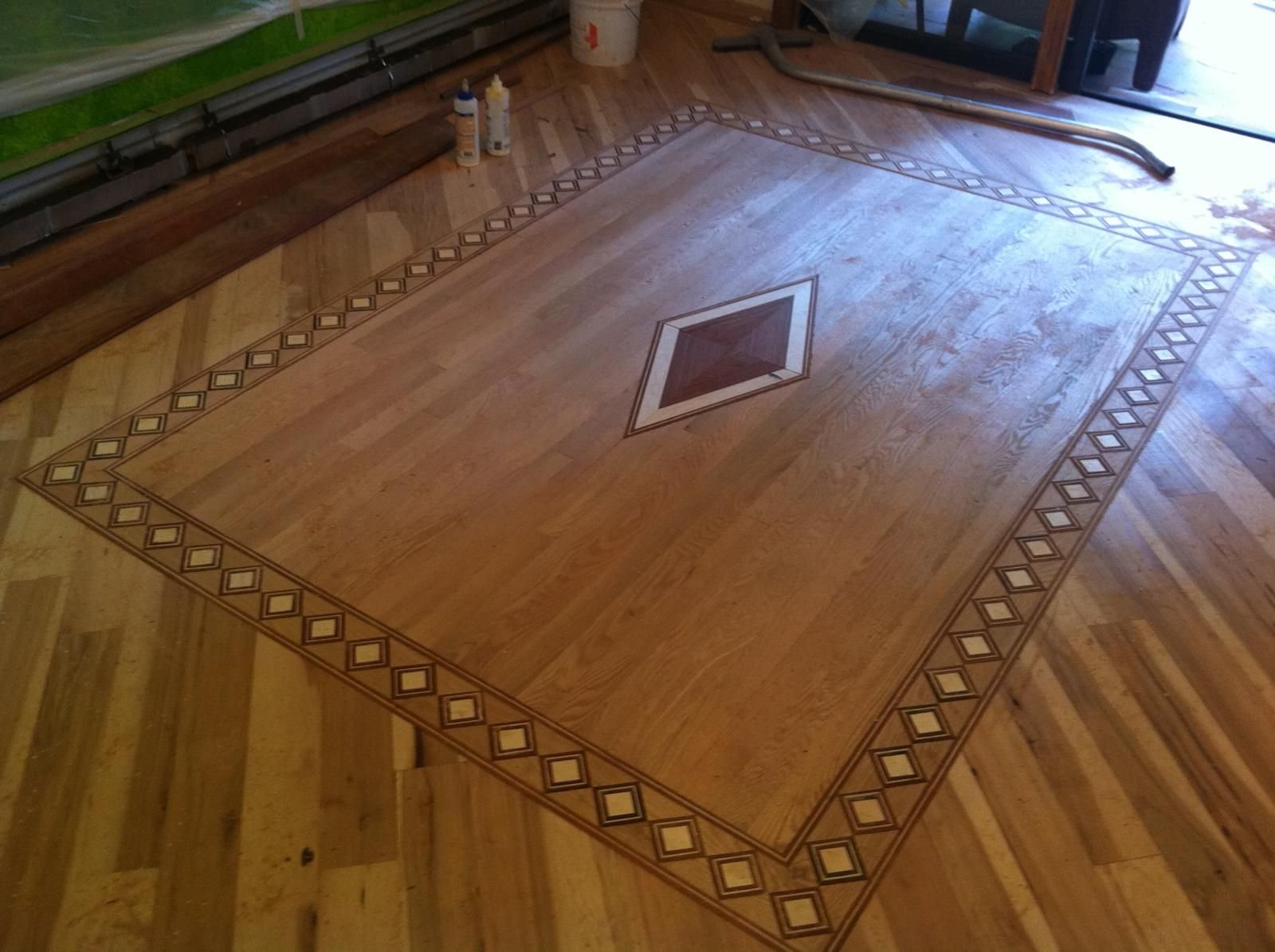
    The pieces are cut and fitted dry, so every joint gets checked before anything is permanent. A compass rose is hundreds of edges that all have to close; a diamond border has to arrive at each corner in rhythm. Dry assembly is where those errors are cheap.

    Most of the hours in a commission live in this stage, and none of them are visible in the finished floor. That is the trade you are buying.

  5. 05

    Laid to the centerline, sanded as one surface

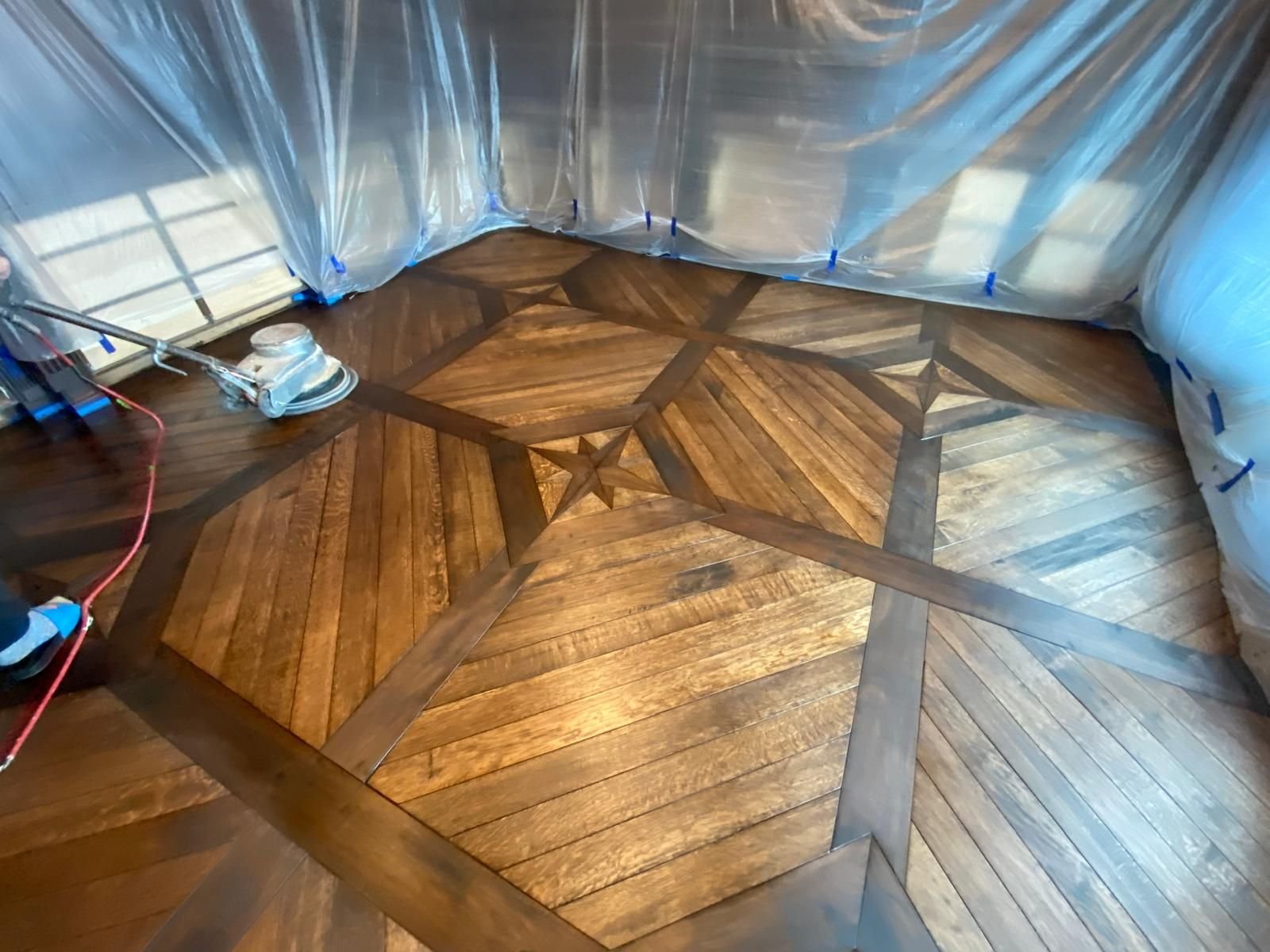
    The field is laid to the drawn centerline so the pattern stays square to the walls. Pattern work is set into it, or routed into an existing floor where the commission is going into a finished room. The whole floor is then sanded flat and finished as a single surface, so pattern and field share one plane and one sheen.

    Wood is acclimated in the house before installation, and moisture is measured in both the subfloor and the material. Those readings are recorded, because a floor that goes down at the wrong moisture content will report it every winter.

    You get back
    A finished floor, and care instructions for the finish that was used.
    Double diamond border set into an oak field before sanding, with the diamond inlay at center — oak, custom commissionStar parquetry field being sanded under plastic sheeting, border and star already laid — custom commission

Commissions

Step one is an email

Send the room and one image of what you like. The first read costs you nothing but the time it takes to attach a photo.